 ← The Blog
How Cuban Exiles Built a Neighborhood That Was Supposed to Be Temporary
The history of Little Havana starts in January 1959, when Fidel Castro's forces took Havana. Within weeks, the first flights of Cuban exiles started landing in Miami. Most of them packed for a few months. Some packed only what they could carry on the plane.
They were wrong about how long they'd be gone.
What those families built in the meantime — between January 1959 and now — is the neighborhood you walk through when you visit Calle Ocho. It wasn't planned. There was no developer, no master plan, no city committee that decided "this will be Little Havana." It was built incrementally, by people who kept thinking they were going home, and kept not going home, and slowly realized this was home now.
That contradiction — temporary place that became permanent — is the whole story. Once you see it, you can't unsee it.
Before It Was Little Havana
The neighborhood Cubans moved into wasn't empty. Before 1959, the area west of downtown Miami — bounded roughly by the Miami River, Flagler Street, and 27th Avenue — was a mix of working-class Anglo and Jewish neighborhoods, with bungalow homes built in the 1920s and 30s. Calle Ocho was Southwest 8th Street, a regular Miami commercial strip with American diners, hardware stores, and Jewish delis.
When the first wave of Cubans arrived, they didn't move there because it was Cuban. They moved there because it was cheap. Rents were low. The bungalows were small but available. It was close to downtown jobs. The neighborhood was already in slow decline as younger residents moved to newer suburbs in the 1950s.
What the Cubans found was an empty stage. And over the next thirty years, they redecorated it completely.
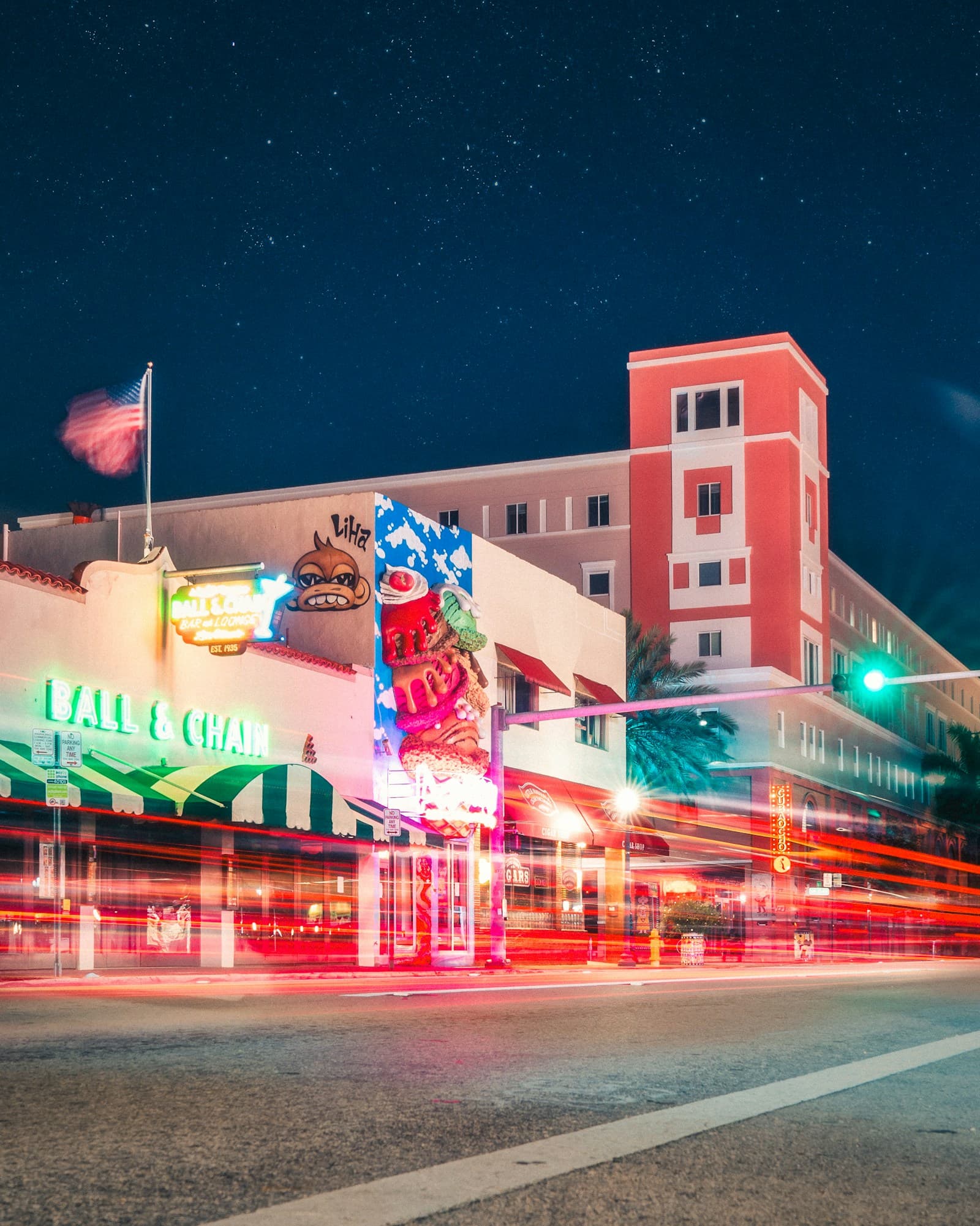
By the late 1960s, the Jewish delis had become Cuban bakeries. The American diners had become cafeterías serving croquetas and cortaditos. The hardware stores had become bodegas. The street signs got bilingual additions. Southwest 8th Street became Calle Ocho not because anyone renamed it officially — that didn't happen until later — but because everyone called it that, and eventually the city caught up.
This is how Little Havana was actually built: not by design, but by accumulation.
The Four Waves
Most articles about Little Havana treat Cuban immigration as one event. It wasn't. There were four distinct waves between 1959 and 2000, each one different, each one changing the neighborhood differently. If you don't understand the waves, you don't understand why people on the same block speak with different accents, eat slightly different food, and disagree about politics that don't seem to be about anything.
The First Wave (1959–1962): The Golden Exiles. Roughly 250,000 Cubans came in the first three years after the revolution. They were largely the professional class — doctors, lawyers, business owners, accountants. They had assets in Cuba that Castro's government nationalized. Many had family connections in the U.S. and educations that translated quickly. They settled in Little Havana because it was affordable and convenient. They expected to be back in Cuba within months. Some of them didn't unpack their boxes for two years.
This wave built the foundation of Cuban Miami. The first Cuban-owned businesses on Calle Ocho — bakeries, cigar shops, restaurants — were opened by people from this wave, often with money pooled from extended family. They built the Cuban exile political machine that still dominates Miami politics today. They are also the reason there are so many small businesses on Calle Ocho instead of corporate chains: this generation believed deeply in business ownership as both economic survival and political statement.
The Second Wave (1965–1973): The Freedom Flights. After a four-year gap during which Cuba and the U.S. had no formal way for people to leave or arrive, Castro and Lyndon Johnson agreed in 1965 to organize what became called the Freedom Flights. From 1965 to 1973, twice-daily flights from Varadero to Miami brought roughly 300,000 more Cubans. This wave was more middle-class than the first — clerks, teachers, smaller business owners — but still skewed toward people with resources to leave.
By the time the Freedom Flights ended, Little Havana was unmistakably Cuban. Half a million people had been relocated to Miami in fifteen years. The neighborhood couldn't hold them all — many spread out into Hialeah, Westchester, and other parts of Miami-Dade — but Calle Ocho remained the symbolic and commercial center.
The Third Wave (1980): The Mariel Boatlift. This is the wave that changed everything. Between April and October of 1980, 125,000 Cubans came to Florida in six months, mostly on small boats from the port of Mariel. Castro had announced anyone who wanted to leave could leave, then loaded the boats with whoever showed up — including, deliberately, some people from prisons and mental institutions.
The Marielitos were poorer than the earlier waves, often Black, often with no professional credentials, and they arrived during a recession. Tensions in the neighborhood were real. The earlier waves of Cubans, who had carefully built their reputation in Miami over twenty years, suddenly felt their image threatened by association. Some of those tensions never fully resolved.
But the Marielitos also reshaped the neighborhood. They opened smaller, scrappier businesses — fritas stands, mechanic shops, working-class bars. They brought Afro-Cuban religion (Santería) more visibly into Miami life. They changed the music. The Cuban music you hear on Calle Ocho today owes more to the Marielitos than to the Golden Exiles.
The Fourth Wave (1994 onward): The Balseros. The fourth wave came on rafts. After Cuba's economy collapsed when the Soviet Union fell, Cubans started crossing the Florida Straits in homemade rafts — balsas — at scale. In August 1994 alone, over 30,000 people attempted the crossing. The U.S. policy at the time, "wet foot, dry foot," meant if you made it to land, you could stay; if you were caught at sea, you went back.
The Balseros were the poorest wave, and the most desperate. Many had grown up entirely under Castro and had never known another Cuba. They didn't share the same political certainty as the earlier waves — they hadn't lost businesses or estates, because there hadn't been any to lose. They came because Cuba was no longer survivable.
This is the wave that put the most strain on Little Havana itself, by then aging and starting to gentrify around the edges. Many Balseros couldn't afford Calle Ocho and moved further west, into Hialeah and Sweetwater. But they kept coming to Calle Ocho — to eat, to shop, to argue politics, to play dominos. The neighborhood became a place that didn't fully belong to anyone, and belonged to all of them.
What Got Built
It's worth being specific about what these four waves actually constructed, because "they built a neighborhood" is too abstract. Walk Calle Ocho today and here's what you're looking at:
Máximo Gómez Park (Calle Ocho between 14th and 15th Avenue) opened in 1976, when the city of Miami designated a small lot as a public space for Cuban exiles to play dominos. They had been playing in private homes and back rooms for fifteen years already. The city recognized what was happening and made it official. Today the same men, or their sons and grandsons, still play there every afternoon. The youngest regular player is in his sixties.
El Crédito Cigar Factory (1106 SW 8th Street) opened in 1968, founded by Ernesto Carrillo Sr., who had run a cigar factory in Cuba before fleeing. The factory has been continuously operating in the same building since. The current rollers learned from the previous generation, who learned from the founders, who learned in Havana. There is an unbroken chain of cigar-rolling technique going back to Cuba in the 1950s, preserved entirely on 14th Avenue.
Versailles Restaurant (3555 SW 8th Street) opened in 1971 and has been called "the unofficial city hall of Cuban Miami" for fifty years. Every Cuban-American politician for half a century has held campaign events there. When Fidel Castro died in 2016, the celebration outside Versailles lasted three days. The architecture is mid-century kitsch, all mirrors and chandeliers and gold trim. It looks like a Havana restaurant from 1958, and that's deliberate.
The Tower Theater (1508 SW 8th Street) is older than Cuban Miami — built in 1926 — but it became a Cuban institution in the 1960s when it started showing American films with Spanish subtitles for newly-arrived exiles trying to learn English. For a generation, it was where you went to watch movies if you didn't speak the language yet. It still operates, now as an art house cinema run by Miami Dade College.
Paseo de las Estrellas (the Walk of Fame, along Calle Ocho between 12th and 17th Avenue) was installed starting in 1989. The stars commemorate Latin entertainers — Celia Cruz, Gloria Estefan, Willy Chirino, dozens more. It's the most touristy stretch of Calle Ocho, but the choices of who got stars (and who didn't) are themselves a political document about which version of Cuban culture got endorsed.
The botánicas — shops selling religious supplies for Santería and Catholic devotion — are scattered throughout the neighborhood. Most opened after the Mariel boatlift in the 1980s, brought by Afro-Cuban exiles whose religious practices the earlier waves had often hidden or downplayed. They sell candles, statues, herbs, and ritual objects. They are not for tourists, though tourists are usually welcomed politely if they're respectful.
The Politics That Won't Go Away
You can't write about Little Havana without writing about Cuban exile politics, because the politics is still alive in a way most American immigrant communities have moved past.
The first wave of exiles was, by and large, anti-Castro to a degree that's hard to describe to people who haven't grown up in Miami. They lost everything — businesses, homes, family members, a country — and their politics calcified around that loss. For sixty years, Cuban Miami has voted overwhelmingly Republican because the Republican Party has been more reliably anti-Castro than the Democrats.
This is changing slowly, mostly because the younger generations are further from the original loss. A Cuban-American born in Miami in 1995 has a different relationship to Cuba than her grandfather, who fled in 1962. But on Calle Ocho, the older generation still dominates the conversation. The men at the ventanitas are reading Diario las Américas and arguing about Cuba in the same terms they were using forty years ago.
This is part of what makes Little Havana feel different from other immigrant neighborhoods in America. Most communities eventually integrate, lose their political identity, become "Italian-American" or "Irish-American" in a sentimental rather than active sense. Cuban Miami hasn't done that. The exile politics is not historical; it's current. The conversations you'll overhear at a bakery in 2026 are about Cuba, in real time, the way they were in 1986 and 1966.
If you don't understand this, the neighborhood looks like a colorful tourist district with cigars and music. If you understand it, you're walking through one of the few places in America where a sixty-year-old political wound is still openly bleeding.
What Walking the Neighborhood Actually Means
This is why a tour matters, and why a guidebook doesn't.
You can read about the Mariel boatlift on Wikipedia. You can look up Versailles Restaurant on Yelp. You can google Máximo Gómez Park and see photos of dominos. None of that gives you the thing that matters, which is standing in front of these places with someone explaining how they connect.
When you stand outside El Crédito and watch a roller in his seventies finishing a cigar with the same motions he learned in 1972, you're seeing an unbroken thread back to a Cuba that no longer exists. When you sit at the counter of a cafetería and the man next to you orders a colada con tres tazas and offers you one of the little cups, you're being included in something that's still going on, not visiting something that already happened.
A walking tour gives you the timeline, the names, the dates, the buildings — but mostly it gives you the attention. Most visitors to Little Havana spend ninety minutes there, take photos at the rooster statues, eat lunch at Versailles, buy a cigar, and leave. They've technically been there. They haven't seen anything.
A 2.5-hour tour, walking pace, with someone who can actually explain what you're looking at, is the difference between visiting a place and understanding one. After the tour, most guests tell me they could come back to Calle Ocho on their own and find their way around. That's the real point.
A Place That Was Supposed to Be Temporary
Little Havana was never planned to exist. It was built by people who thought they were going home in six months. Sixty years later, they're still here, still making cortaditos, still arguing politics, still rolling cigars, still playing dominos every afternoon at Máximo Gómez Park.
What started as a holding pattern became a neighborhood. What was supposed to be temporary became one of the most distinctive cultural communities in the United States. The contradiction is the point. You're walking through a place that was built by accident, and built so well that the accident is now what defines it.
That's what these tours are for. Not to teach you facts you could read on a plaque, but to put you in front of the actual places, with the actual context, with the actual people still living in them.
Once you've seen Little Havana that way, you've actually been to Miami.