

A railroad, and a woman who refused to be ignored.
Miami, the city, is younger than the Brooklyn Bridge. It was incorporated on July 28, 1896 — and it almost wasn't. It took a Cleveland widow named Julia Tuttle, who owned a citrus grove on the north bank of the Miami River, to convince railroad tycoon Henry Flagler that this swampy outpost was worth a railhead. The legend says she mailed him an unfrozen orange blossom after the Great Freeze of 1894–95 wiped out citrus everywhere else in Florida. The point landed.
Flagler extended his Florida East Coast Railway to the river. Within months, a town appeared. The 502 men who voted at the incorporation meeting wanted to name it “Flagler.” He refused, and so it became Miami — from the indigenous Tequesta word the river had carried for centuries. Tuttle is the only woman in American history to found a major U.S. city. Most maps still don't mention her.
Carl Fisher dredges a barrier island into existence.
Across the bay, the strip we now call Miami Beach was a tangled mangrove sandbar, home to coconut farmers and almost nothing else. Indianapolis Motor Speedway co-founder Carl Fisher saw a different future. He bought up the land, hired barges to dredge sand from the bottom of Biscayne Bay, killed the mangroves, and shaped a modern resort island out of muck. Miami Beach was incorporated in 1915.
Fisher imported elephants for promotional photos. He built the polo grounds, the golf courses, the first generation of hotels. Then came the 1920s Florida land boom — speculators arrived by train, plots flipped three times in an afternoon, fortunes were made on paper.
The hurricane that ended the boom.
The party stopped on September 18, 1926. The Great Miami Hurricane — a Category 4 that hit before the National Weather Service named storms — slammed into a population that had never experienced one. Three hundred and seventy-two people died. The land boom collapsed overnight. Florida entered the Great Depression three years before the rest of the country.
Empty lots, half-built hotels, bankrupt developers. From a distance it looked like the end of Miami. It was actually the setup for what came next — because the cheap land would soon be bought by a small army of architects who had been waiting for their canvas.
Pastel walls go up. Art Deco arrives.

Between roughly 1925 and 1942, three architects — Henry Hohauser, L. Murray Dixon, and Albert Anis — built more than 800 buildings on a one-square-mile patch of South Beach. Most of them are still there. They are why the neighborhood looks the way it looks. Rounded corners. Glass block. Porthole windows. Eyebrow ledges shading the windows from the Florida sun. Neon at night. Pastel by day. This is the largest concentration of Art Deco architecture in the world.
The style was an answer to the moment: the Depression had killed extravagance, but the Beach still wanted glamour. Art Deco delivered both — cheap to build, cinematic to look at. The Colony, the Carlyle, the Cardozo, the Marlin, the Cavalier, the Tides — Ocean Drive became a cardboard movie set you could actually live inside.
On our South Beach walking tour we walk Ocean Drive and the side streets, and you'll see the architecture differently afterwards.
The Army takes over the hotels.

When the U.S. entered World War II, the Army Air Forces needed a basic training center fast. Miami Beach had hundreds of empty hotels and a built-in barracks capacity nobody else could match. The military moved in. Cadets slept in the Cadillac and the Versailles. They drilled on the sand. They marched up Washington Avenue in formation. Roughly 500,000 servicemen passed through Miami Beach during the war.
A lot of those young men remembered the place. After the war, they came back as tourists — and brought their families. The postwar boom was a direct consequence of the wartime occupation.
Morris Lapidus and the Fontainebleau.

By the early 1950s, Art Deco felt small. The new money wanted spectacle. Architect Morris Lapidus answered with the Fontainebleau on Collins Avenue — a curved, marble, terrazzo-floored, swooping cathedral of postwar excess. It was reviewed as a vulgar mistake by the architectural press. Frank Sinatra filmed there. So did the Rat Pack. James Bond was about to. The public adored it.
Lapidus called his style “the architecture of joy.” Today it has its own name: MiMo, for Miami Modern. It's the second great architectural layer on the Beach, sitting two blocks north of the Art Deco strip and largely ignored by tourists who don't know what they're looking at.
A revolution in Cuba arrives at Miami International.
Fidel Castro came down from the Sierra Maestra on January 1, 1959. Within weeks, the first wave of Cuban exiles — many of them business owners, professionals, landowners — were boarding flights to Miami. They settled in the cheapest part of the city they could find: a working-class neighborhood west of downtown built mostly by Jewish and Southern transplants in the 1920s, full of small bungalows and 1925-era apartment buildings on the long east-west corridor of SW 8th Street.
Calle Ocho. Eighth Street. The name is the address. Within a decade the bakeries spoke Spanish, the radio stations spoke Spanish, the cigar rollers from Tampa opened second shops, and the neighborhood had a new name nobody had to vote on.
Our Little Havana walking tour starts at Domino Park and traces this story block by block.
Versailles opens. The exile community has a living room.
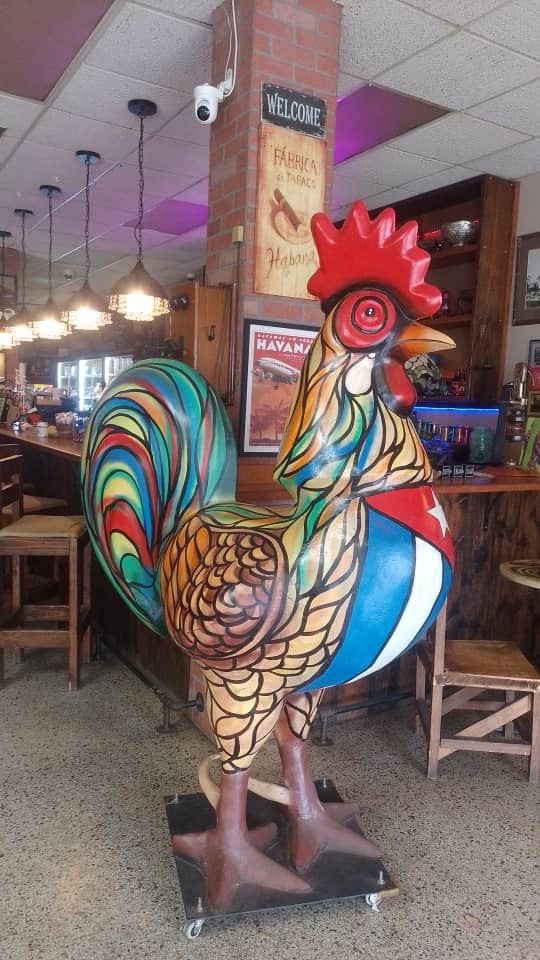
Versailles Restaurant opened on SW 8th Street in 1971. Within a year it was the unofficial parliament of the exile community — the place where political deals got made over café cubano at the ventanita window, where presidential candidates came to be photographed eating pastelitos, where the news of every Cuban moment for the next fifty years would first be argued in public.
Two blocks east, a small triangle of concrete became Domino Park (officially Maximo Gomez Park). Old men in guayaberas slammed double-nines onto folding tables. They're still there. The 1925 architecture, the Buicks and Bel Airs parked at the curb, the smell of espresso and cigar leaf — Little Havana is the only neighborhood on these tours where the texture has been continuously preserved by the people who live in it, not by a preservation board.
The Mariel Boatlift changes Miami forever.

In April 1980, Castro briefly opened the port of Mariel and announced that anyone who wanted to leave Cuba could go. Over the next six months, roughly 125,000 Cubans — the “Marielitos” — crossed the Florida Strait in a flotilla of shrimp boats, fishing trawlers, and anything else that would float. Most of them landed in Miami. The city absorbed them, badly at first. Crime spiked. Tent cities opened under Interstate 95.
The Mariel wave is why Miami is today, by some measures, more Cuban than Havana. It's also why the city pivoted permanently into a Latin American capital — by the late 1980s Miami was the de facto banking and media hub for the entire Spanish-speaking hemisphere.
Barbara Capitman saves the Art Deco district.
By the late 1970s, South Beach was a slum. The hotels were SROs for elderly retirees on fixed incomes. Developers wanted to bulldoze the entire strip and put up condos. A small, fierce woman named Barbara Capitman — a former design journalist living in Miami — said no.
In 1976 she founded the Miami Design Preservation League. In 1979 she got the Miami Beach Architectural District added to the National Register of Historic Places — the first 20th-century district ever to get that protection. Several Deco hotels were saved on the day demolition equipment arrived. The pastel paint scheme you now associate with Ocean Drive — pink, mint, lavender, sky blue — was added in the 1980s by designer Leonard Horowitz, partly because Capitman's movement was making the buildings worth photographing again.
Miami Vice premieres. The aesthetic goes global.
Michael Mann's television show used South Beach as a permanent location. The opening sequence — flamingos, Cigarette boats, Jan Hammer synth, a Ferrari Daytona on Ocean Drive at dusk — was the most expensive TV title sequence ever made at that time. It also functioned as a five-year tourism commercial for a neighborhood that, before the show, most Americans associated with cocaine cowboys and retirees.
By the late 1980s, fashion shoots had taken over Ocean Drive. Versace bought the mansion next to the Casa Casuarina in 1992. The pastel hotels were now backdrops for Vogue editorials. Property values doubled, then doubled again.
Little San Juan, before the murals.

Forty blocks north of downtown, in an industrial pocket bounded roughly by I-195, I-95, and NW 36th Street, sat a neighborhood that didn't have a name on most maps. Locals called it Little San Juan. It had been a Puerto Rican working-class neighborhood since the 1950s, sandwiched between the city's old garment district to the south and a string of warehouses, paint shops, and a defunct RC Cola bottling plant to the north.
By the 1990s the garment industry had left. The warehouses were cheap, often empty. A few artists moved in for the rent. Galleries opened in old furniture showrooms. It was nobody's neighborhood. That was the point.
Tony Goldman buys the warehouses. The Walls go up.
Real estate developer Tony Goldman — the man who had previously revived SoHo in New York and parts of South Beach — started buying Wynwood property in 2002. He had a theory: the windowless warehouse walls, ugly to most people, were eight-story canvases waiting for paint. In 2009 he opened Wynwood Walls, an outdoor museum of large-format murals on six warehouses around NW 2nd Avenue and 26th Street.
The timing was deliberate. Art Basel Miami Beach had launched in 2002 across the causeway, and every December the international art world showed up in town with nothing to do during the day. Goldman gave them somewhere to walk. He invited street artists with international reputations — Shepard Fairey, Os Gêmeos, Kenny Scharf, Ron English — to paint the walls. Within five years, Wynwood was the single most-photographed neighborhood in Miami.
If you want to see this in person, our Wynwood walking tour covers the full Walls circuit plus the side streets most tourists miss.
Three neighborhoods, one continuous story.
South Beach: a hundred years of architecture stacked on top of each other — Mediterranean Revival, Art Deco, MiMo, postmodern condo towers, and now the glassed-in starchitecture of Faena and Surf Club. Most tourists see one block of it.
Little Havana: a 1920s neighborhood that became, in 1959, the staging ground of an exile community that never left. The architecture is older than anywhere else on these tours. The street life is louder.
Wynwood: the youngest of the three by half a century. The walls are repainted constantly. What was on a building two years ago is gone. What you see this month you may not see again. That's the point.
The three of them are within ten miles of each other and they each tell a different chapter. Walk all three with someone who lives here, and you have the city.