 ← The Blog
How a Warehouse District Became the Most Photographed Neighborhood in Miami
The history of Wynwood is shorter than people think. In 2008, you didn't walk through Wynwood at night. The warehouses were mostly empty, the streets were poorly lit, and the only people on them after dark were either going somewhere they didn't want to advertise or had nowhere else to go. The neighborhood had been declining for thirty years.
By 2013, the same blocks were one of the most photographed areas in the United States. International artists were flying in to paint walls. Restaurants opened, then closed, then reopened with bigger investors. Galleries moved in, then luxury apartments. Property values went up by some of the steepest rates in American urban history.
That transformation happened in about five years. Almost nothing else in the country has changed that fast.
The neighborhood you photograph today — the murals, the breweries, the design shops — is real. But it's only the most visible layer of what's there. Underneath it is a history that includes Puerto Rican garment workers, a single developer who saw what nobody else did, hundreds of artists who can't afford to live there anymore, and a battle over what neighborhoods are for that hasn't been resolved.
Once you know how Wynwood actually got built, the murals stop being decoration. They become the cover of a much more interesting book.
Before It Was Wynwood
The land that became Wynwood was farmland until the 1910s, when Miami started building rail connections and the area got rezoned for industry. The first warehouses went up in the 1920s, serving the garment industry — clothing manufacturing, textile distribution, leather goods. By the 1940s, Wynwood was one of Miami's main industrial districts.
In the 1950s and 60s, Puerto Rican migration to Miami hit its peak, and Wynwood became known as "El Barrio" — Miami's Puerto Rican neighborhood. Tens of thousands of Puerto Rican families settled in the homes east and west of the warehouse district. The men worked in the factories. The women often worked in the same buildings, on the assembly lines making clothing for American department stores. There were Puerto Rican grocery stores, restaurants, social clubs, churches. The neighborhood had a distinct Caribbean accent.
By the 1980s, the garment industry was leaving Miami — first for cheaper Southern states, then for Mexico, then for Asia. The factories closed one by one. The Puerto Rican families who had worked in them either followed the work elsewhere or got stuck in a neighborhood that no longer had a reason to exist.
Through the 1990s and early 2000s, Wynwood was an industrial ghost town. The warehouses sat empty. Some were used for storage. A few got divided into cheap artist studios — Miami artists who needed space and didn't mind a rough neighborhood. The blocks were patrolled by police but considered too far gone for serious investment. The Puerto Rican community that remained was concentrated in the residential edges, mostly poor, increasingly elderly.
This is the Wynwood that Tony Goldman saw in 2008.
Who Tony Goldman Was
The story of Wynwood's transformation is, more than any other Miami neighborhood, the story of one developer.
Tony Goldman wasn't a Miami native. He was a New York real estate developer who had made his name in the 1970s and 80s by buying cheap, decaying neighborhoods and redeveloping them with a specific philosophy: don't tear down the old buildings, don't bring in chain stores, build slowly with local artists and small businesses, and let the neighborhood discover what it wants to be.
He had done this in SoHo in the 1970s, when SoHo was abandoned cast-iron warehouses. He had done it on South Beach in the 1980s, when South Beach was a struggling retirement community whose Art Deco buildings were being demolished. By the time he turned his attention to Wynwood, he had a track record of taking neighborhoods nobody else wanted and turning them into the most desirable real estate in their cities.
Goldman started buying in Wynwood in 2004, and over the next four years he assembled a substantial holding of warehouse buildings, much of it concentrated around NW 2nd Avenue between 25th and 26th Streets. The blocks were, at the time, almost entirely vacant. He paid prices that real estate professionals considered insane — but only because they didn't see what he saw.
What Goldman saw was a blank canvas. Literally. The warehouse walls were enormous, mostly windowless, mostly bare concrete and brick. He didn't want to convert them into shops or housing. He wanted to commission artists to paint them.
This was the idea that became the Wynwood Walls.
How the Walls Got Built
The Wynwood Walls launched in December 2009, debuting during Art Basel Miami Beach — the international contemporary art fair that since 2002 had been bringing the global art world to Miami every December. Goldman's bet was that if he could get serious artists to paint the walls during Basel week, the international art press would write about it, and Miami's art collectors would start paying attention to a neighborhood they had never heard of. The following year, in 2010, he expanded the project with "Wynwood Doors," adding garage-door-sized canvases for additional artists.
The first round of artists he commissioned was deliberately heavyweight. Shepard Fairey (the artist who had made the iconic Obama "Hope" poster the year before). Os Gemeos, the Brazilian twins whose work was already in major museums. Futura, a graffiti pioneer from New York. Kenny Scharf, who had come up alongside Keith Haring and Basquiat in 1980s New York. These were not local artists. They were already-famous figures whose presence in Wynwood would generate immediate attention.
It worked. The art press covered it. Collectors came down for Basel and walked through the murals. Within a year, Wynwood had a reputation. Within two years, it had restaurants. Within three years, real estate prices on the surrounding blocks had doubled.
Goldman died on September 11, 2012. By that point, the transformation he had set in motion was unstoppable. His daughter Jessica Goldman Srebnick took over as CEO of Goldman Properties and has continued to lead the Wynwood Walls, curating new artists every year. The Walls themselves are now a paid attraction — you buy a ticket, walk through a controlled gallery space, and see murals that get refreshed periodically by new artists.
The Wynwood Walls are real, and they are genuinely impressive as a curated outdoor museum. But they are not Wynwood.
The Wynwood the Walls Don't Show You
Here's the part of the story that doesn't make it into the marketing materials.
When Goldman launched the Walls in late 2009, the surrounding blocks were full of small businesses and working-class residents — many of them the remnants of the Puerto Rican community that had been there for fifty years. Garages, family-owned auto body shops, botánicas, small grocery stores, low-rent apartments. The kind of small commercial fabric that takes generations to build and weeks to lose.
Within five years of the Walls opening, rents on the surrounding blocks rose by an average of 400%. Some specific blocks saw rents go up 600%. The auto body shops couldn't afford to stay. The botánicas couldn't afford to stay. The Puerto Rican grandmothers who had lived in the neighborhood since the 1960s, often in rent-controlled apartments, started getting eviction notices. The eviction notices were technically legal — the city's rent control had been weakened in the 1990s — but the moral question of whether you can ethically displace a community to make room for an art district is still being argued.
This isn't a secret. It's been written about. There are documentaries about it. But it doesn't show up in tour brochures, because tour brochures don't sell that story. The story they sell is "vibrant arts district." The story that's harder to tell is "vibrant arts district built on the displacement of the people who lived there first."
Most of the artists who made Wynwood famous in 2009-2012 also can't afford to be there now. The cheap warehouse studios that drew them are gone, converted into galleries with rent that only commercial galleries can pay. Many of those original artists moved to Little Haiti, then got priced out of Little Haiti, and are now in Allapattah, where the same cycle is starting again.
This is the rhythm of American urban gentrification, and Wynwood is one of its clearest examples. A neighborhood that nobody wants becomes a neighborhood that artists can afford. Artists make it interesting. Developers notice. Money comes in. Artists get pushed out. The neighborhood becomes "the next Wynwood." And then the cycle starts again somewhere else.
What's Actually Worth Seeing
Despite everything I just wrote, Wynwood is genuinely worth visiting. The art is real, even if the neighborhood economics around it are complicated. Here's what's actually worth your time.
The Wynwood Walls (2520 NW 2nd Avenue) charge admission — currently in the $12–$15 range, though pricing has shifted over the years (the Walls were once free, then ticketed at lower prices, before reaching the current range). They are a curated outdoor gallery with rotating murals by serious international artists. If you've never seen large-scale public art before, the Walls are an excellent introduction. If you've seen a lot of public art, they're still a strong showcase, just one that's been turned into a paid attraction. Worth doing once.
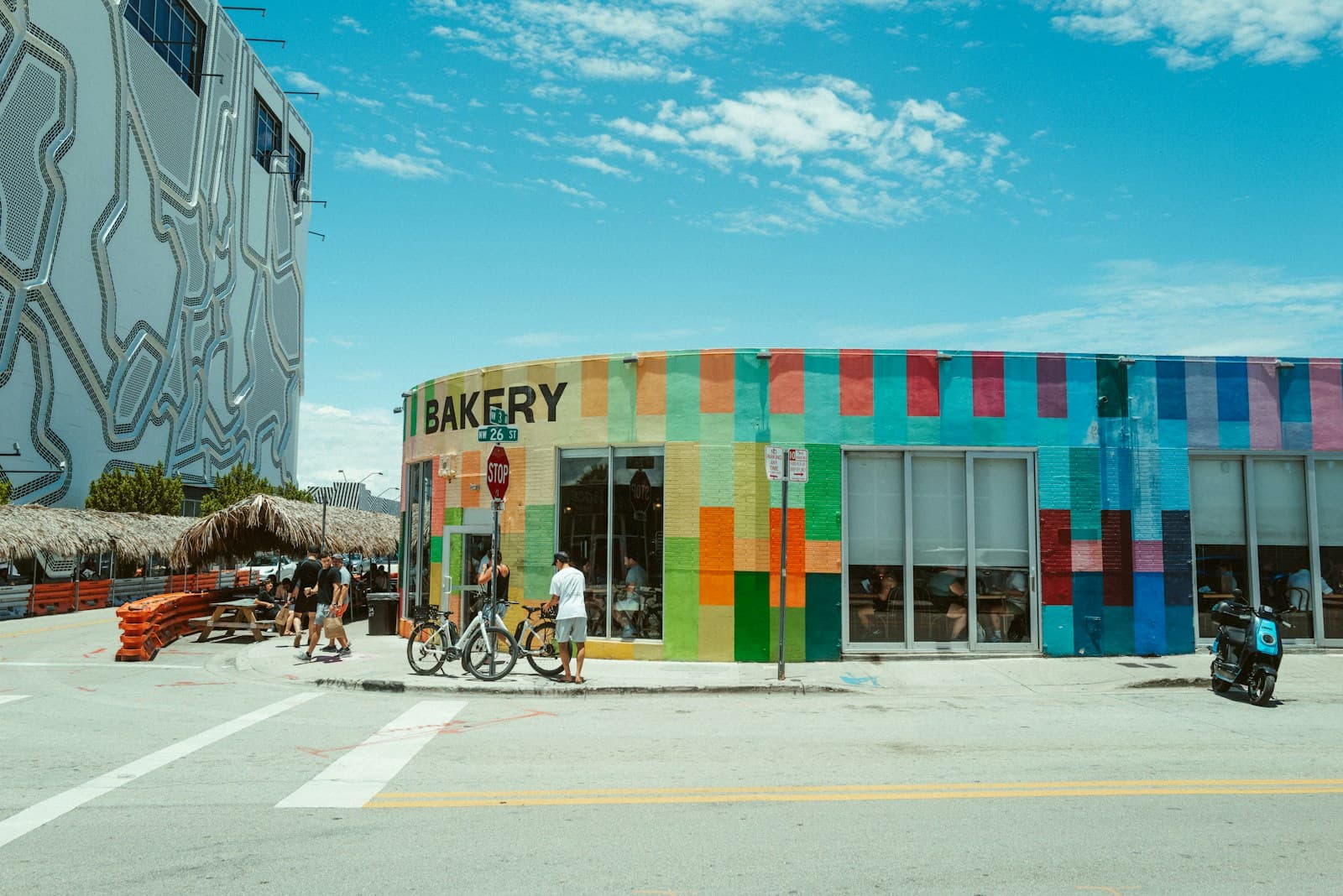
The blocks east of NW 2nd Avenue, especially NW 23rd to 27th Streets, are the streets the Walls don't show you. The murals here are less curated, more political, more raw. Some are by artists who lived in the buildings they painted before getting priced out. Some are unsigned. The street fabric on these blocks is what Wynwood actually was before 2009 — a working neighborhood with auto shops, small businesses, and apartments. This is where you see the contrast between what was and what is.
Wynwood Brewing Company (565 NW 24th Street) was the neighborhood's first craft brewery, opened in 2013 by Luis G. Brignoni and his father — a Puerto Rican family from the neighborhood, which matters. Most of the businesses that opened in Wynwood after 2010 were started by outside investors. The Brignonis were among the few founders who had grown up in the area and stayed. The brewery is still operating and is one of the most unambiguously good places in Wynwood.
Panther Coffee (2390 NW 2nd Avenue) opened in 2010 and was one of the first businesses to bet on Wynwood as a daytime destination. The coffee is excellent. The space, in a converted warehouse, was designed to look like the warehouse it used to be. It's the kind of place that documents what Wynwood became and quietly forgets what it was before.
The 2nd Saturday Art Walk, held the second Saturday of every month, is when the galleries stay open late and the streets fill with people. It's the most crowded time in Wynwood, the most touristy, and also the most fun. The galleries you can wander into for free, on the same night, range from major contemporary spaces to small artist-run rooms. If you only have one night in Wynwood, it should be a 2nd Saturday.
The murals on the side streets, walked slowly, are the actual reason to come. Not the Walls. The walls. Streets like NW 23rd Terrace, NW 26th Street between 2nd and 3rd Avenues, the alleys behind the main blocks. This is where you see murals that haven't been curated, painted by artists who weren't paid by a developer. Some are excellent. Some are forgettable. All of them are more honest than what you see inside the ticketed gallery.
What Walking Wynwood Actually Means
You can see most of Wynwood in a couple of hours on your own. The murals are on the streets; nobody's stopping you from looking at them. You can walk into Panther Coffee, walk through the Walls if you buy a ticket, eat at one of the restaurants, take photos.
What you can't get on your own is the context. Which mural was painted before the Walls existed and which was commissioned afterwards. Which buildings were warehouses and which were apartments where families lived. Which businesses are owned by people who grew up in the neighborhood and which were started by investors who flew in from Brooklyn. The 4-mile-an-hour walk past a wall, with someone explaining what you're looking at and what you're not seeing, is what turns Wynwood from a backdrop into a place.
A 2.5-hour walking tour gives you the timeline — from the garment factories to the murals to the brewery boom to the current condo construction — in the order it happened, while you're standing in front of the actual buildings. You see how the layers stack. You see what Tony Goldman saw, and you see what Tony Goldman missed. You see why people are mad and you see why they're not. You leave with an actual relationship to the neighborhood, not just photos.
After the tour, most guests tell me they'd come back to Wynwood on their own — but they'd come back differently. They'd walk the side streets. They'd ask questions at the brewery. They'd notice the difference between the Walls and the walls. That shift, from looking at a place to seeing it, is what the tour is for.
A Neighborhood in Mid-Sentence
Wynwood is not a finished neighborhood. The blocks immediately around the Wynwood Walls are gentrified and stable. The blocks two and three over are still in transition — some warehouses being converted, some demolished for high-rises, some still operating as the businesses they've always been. The blocks five and six over are starting to see the same investment that hit the core in 2009.
In ten years, Wynwood will be different again. The current art district is already being talked about as a "creative office hub" by developers, which is the language people use when they're about to convert galleries into headquarters for tech companies. The murals will probably stay — they're the brand at this point — but the people who paint them, and the people who live around them, will keep getting moved.
This is the part of the story that's still being written. Walking the neighborhood now means walking through a place mid-sentence, with the ending unclear. That's the most interesting time to see it.
In a couple of years, the version of Wynwood you see today will be gone. The next version will have its own logic, its own contradictions, its own things worth showing you. But the version that exists now — half art district, half construction site, half gentrification cautionary tale, half functioning neighborhood — will only exist for a few more years.
If you're going to see it, this is the time.