 ← The Blog
Most people who visit Miami want to see it like a local — the off-the-beaten-path Miami that doesn't show up on the hotel concierge's map. Instead they spend three days on South Beach, eat at a restaurant they could have found in any city, and leave thinking they've seen Miami.
They haven't.
I don't say this to be dismissive. I say it because I've been walking these neighborhoods for years, and I've watched hundreds of visitors have a completely different experience of the same city — depending entirely on who's with them and how they're paying attention.
The Miami you see from a hotel pool is real. The mojitos are good. The pool deck has a view. But it's a deliberately curated version of the city — designed by people whose job is to make sure you have a pleasant, photogenic, frictionless time. And there's a version of that experience worth having, especially if you've worked all year to be there.
What I want to tell you about is the other version. The one that's harder to find but easier to remember.
What Ocean Drive Actually Is
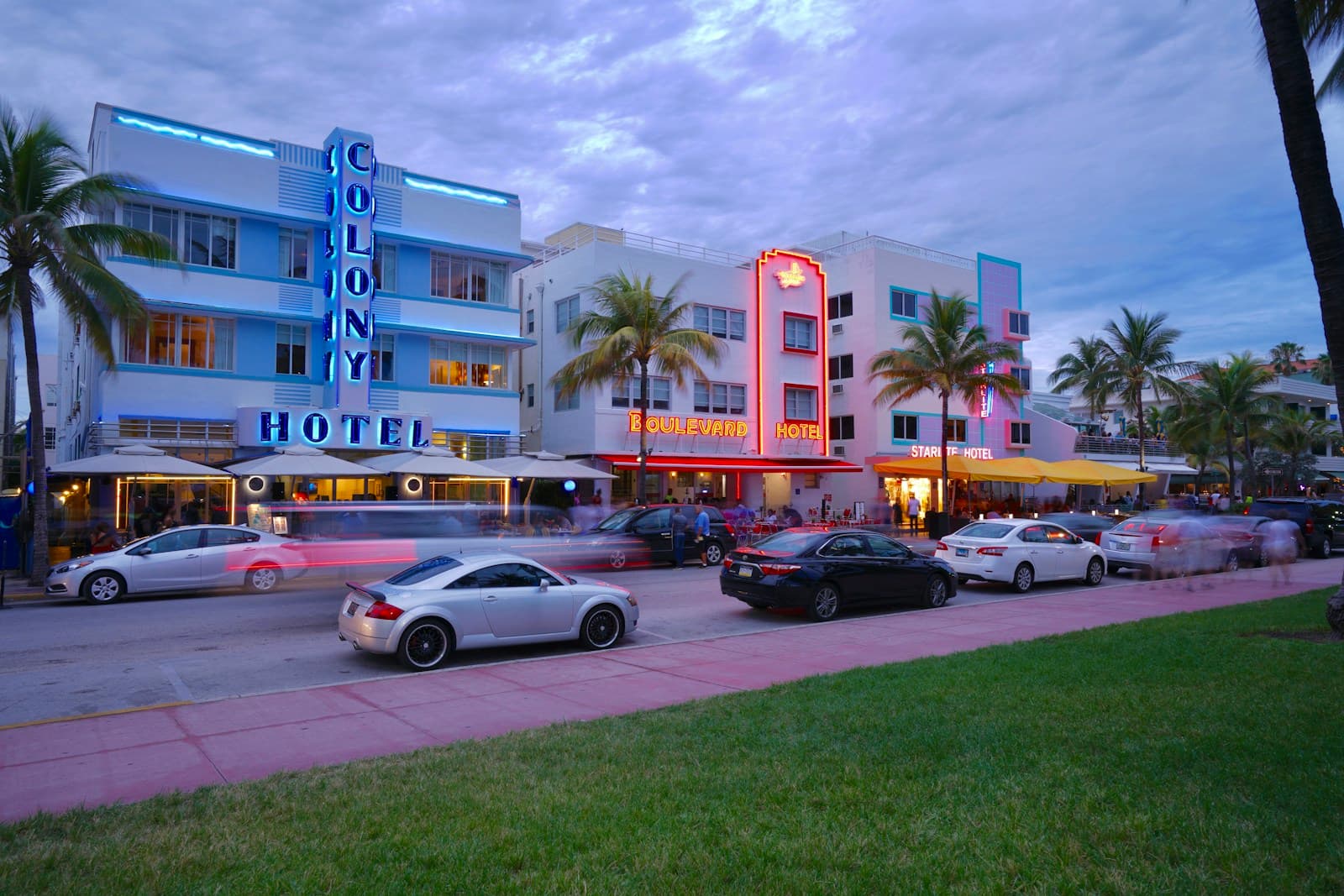
Ocean Drive is one of the most photographed streets in the world. It's also one of the most misunderstood.
Most people see the neon, the hotels, the tourists, the overpriced mojitos. They take a photo. They move on. They've now "done" South Beach.
What they don't see: the Art Deco district is the largest collection of 1930s architecture in the world, and it nearly didn't exist. In the 1970s, most of these buildings were on the demolition list. The neighborhood had become a retirement community in slow decline, and developers were lined up with bulldozers, ready to replace the entire stretch with high-rises.
A woman named Barbara Baer Capitman fought to save them. She founded the Miami Design Preservation League in 1976 with five other women. She was arrested at a demolition site, lying in front of a bulldozer. Her sons were arrested with her. She testified at city council meetings until she lost her voice. And she won — the Miami Beach Architectural District was added to the National Register of Historic Places in 1979, the first 20th-century neighborhood ever protected that way.
Her name is on a plaque most people walk past without noticing.
The Versace Mansion — now a luxury hotel — is one of the most photographed buildings on the street. What most people don't know is what it was before Versace: the Amsterdam Palace, built in 1930 and designed by Henry LaPointe in the Mediterranean Revival style, before Art Deco took over the neighborhood. The same architect designed a third of the buildings on that block. Versace bought it in 1992, and his murder on the front steps in 1997 turned it into a tourist site for the wrong reasons. The architectural story — the fact that you're looking at a 95-year-old palace built by a Cuban-American mogul, not a celebrity gravesite — is what's actually interesting.
That context changes what you're looking at. Architecture stops being wallpaper and starts being an argument — about money, preservation, who gets to decide what a city looks like, and what we lose when we forget.
Walk Ocean Drive once with someone telling you these stories and you'll never see it the same way again. The neon hits differently when you know it's not original — most of the iconic neon was added in the 1980s, when the district was being marketed as a comeback story. The pastel paint colors weren't there originally either. They were a deliberate choice by designer Leonard Horowitz, also in the 1980s, to make the buildings stand out for tourists. Real Art Deco was almost monochrome. The "Miami pastels" you've seen in every photograph of South Beach are essentially a marketing campaign that worked so well people now think they've always been there.
Why Little Havana Is Not a Theme Park
There's a version of Little Havana that exists for tourists. The Walk of Fame, the cigars, the mojitos, the salsa dancing outside the cafés. It's not fake — people genuinely do those things — but it's the curated version. The version that exists because tourists expect it.
And then there's Calle Ocho on a Tuesday afternoon.
The domino players at Máximo Gómez Park have been there every day for forty years. They don't want to be photographed. They're not performing for you — they're playing dominoes, the way their fathers did in Havana, the way they've done every afternoon since the 1980s. If you stand at the fence and watch quietly, sometimes one of them will look up and nod. That's the most you'll get, and it's enough.
The cigar factory on 14th Avenue isn't a museum — it's a working factory, where the rollers have been doing the same job since the 1970s. They roll fifty cigars a day, by hand, the same way they would have in Havana before they left. You can buy one for less than you'd pay for a beer at the hotel bar. They'll smell like wet earth and smoke for hours after.
The ventanita at a bakery on 17th Avenue serves coffee for $1.25. Nobody speaks English to you because they don't need to. The men standing at the window in the morning are reading the paper, arguing about Cuban politics that haven't changed since the 1960s, and ordering coladas to share. If you order one and three little plastic cups, you've ordered correctly. If you ask for a "Cuban coffee," you're announcing that you don't belong. There's no judgment in this — it's just information.
The neighborhood was built by Cuban exiles who came after 1959 thinking they were staying for a few months. They were wrong. They never went home. What they built in the meantime — Little Havana — is a place that is simultaneously Cuban and not Cuban, Miami and not Miami. That contradiction is the whole point.
The first wave came in the early 1960s, professionals and business owners who fled Castro's nationalizations. The second wave came after the Mariel boatlift in 1980 — 125,000 people in six months, many of them poor, some released from Cuban prisons. The third and fourth waves came in the 1990s and 2000s, balseros who crossed the Florida Straits on rafts. Each generation changed the neighborhood. The accents are different on different blocks. The food is different. The politics are different.
What you see on Calle Ocho today is the layered result of sixty years of arrival. None of it is performance. All of it is real. But you have to know what you're looking at, or it just looks like a colorful street with cigar shops.
What Wynwood Was Before It Was Wynwood
The art district you know was a warehouse neighborhood. Garment factories, freight companies, a lot of vacant lots. In the 1990s and early 2000s, it was a place you didn't walk through at night.
The murals started going up around 2009, when Tony Goldman — same family as the development group that revitalized South Beach in the 1980s — started commissioning artists for what became the Wynwood Walls. He bought up cheap warehouse space and turned the exterior walls into a permanent outdoor gallery. The artists were international: Shepard Fairey, Os Gemeos, Retna, Kenny Scharf. The neighborhood became famous in about three years.
The timeline matters. Buildings that had been vacant for decades became galleries, then restaurants, then luxury apartments, in about five years. Rents in the surrounding blocks went up four hundred percent. The garment workers who had been there for two generations got pushed out. The artists who had moved into cheap studios — the same artists who made the murals that made the neighborhood famous — got pushed out next, replaced by developers commissioning safer, more Instagram-friendly work.
This is the part nobody talks about on the tour buses. There are still artists working in Wynwood who remember what it was before. Their murals are the ones in the side streets, not on the main blocks. The Wynwood Walls is the curated, ticketed version. The blocks east of NW 2nd Avenue, especially in the early morning, are the version where the neighborhood is still happening.
If you walk into the Wynwood Walls on a Saturday afternoon, you're seeing one version of the neighborhood — crowded, photogenic, designed to be photographed. If you walk the blocks east of NW 2nd Avenue on a Tuesday morning, you're seeing another. The murals are rougher, less perfect. Some are by artists who lived in the building they painted. Some are political. Some are by people you'll never hear of, whose names aren't on any tour.
That's the version I show people, when I show them Wynwood. Not because the Walls aren't worth seeing — they are. But because if you only see the Walls, you're seeing a museum exhibit. If you see the side streets, you're seeing a neighborhood.
What Walking Actually Does
Here's what most tour companies don't tell you: you can't see Miami from a bus. You can see of Miami from a bus — the skyline, the bridges, the postcard angles — but you can't see the city itself. The city happens at sidewalk level. The smell of the bakery, the sound of the dominos clicking, the way the light hits a 1930s façade at a specific angle in the afternoon. None of that survives a bus window.
Walking is slow. Walking is hot, in Miami, most of the year. Walking is also the only way to actually be somewhere instead of passing through it. And in three neighborhoods that were built before cars dominated American cities — South Beach in the 1920s and 30s, Little Havana around blocks that already existed, Wynwood out of older industrial fabric — walking is how the neighborhoods were meant to be experienced in the first place.
A 2.5-hour walking tour gives you about four miles of slow, attentive movement through one neighborhood. That's enough time to stop at six or seven places, hear the stories, ask questions, take a coffee break, and actually look at things. It's not enough time to see everything — but the goal isn't comprehensiveness. The goal is depth. After a walking tour, most people tell me they could come back to the same neighborhood without me and find their way around. That's the point.
How to Walk a Miami Neighborhood Like You Live Here
Even without a guide, you can change how you experience these neighborhoods. A few things that help:
Go on weekday mornings, not weekend afternoons. The crowds change everything. A neighborhood at 10am on a Tuesday is the version that locals see. The same neighborhood at 3pm on a Saturday is the version designed for visitors.
Stop at one place that doesn't have an English menu. This is the simplest test for whether you're somewhere real. If everything is translated, you're in the tourist version. If you have to point or ask, you're somewhere people actually live.
Pay attention to the architecture, not just the murals. The buildings have stories. The murals are usually less than fifteen years old. The buildings have been there for sixty, eighty, a hundred years.
Ask people what changed. Anyone over fifty in any of these neighborhoods has watched the place transform. Most are happy to talk about it if you actually want to know.
Don't try to do all three neighborhoods in one day. They're too different. You'll mush them together in your memory. Pick one. Spend time. Come back another day for the next.
Why Any of This Matters
You can have a perfectly nice trip to Miami without thinking about any of this. The pool is fine. The brunch is fine. The Instagram photos will be fine. Most people choose this version, and there's nothing wrong with it.
But if you're the kind of person who's read this far, you probably want something else. You want to come home from a trip and have something to actually say about the place — not "the food was great" but "let me tell you about this guy at a domino park, or this woman who saved an entire architectural district, or this neighborhood that got famous in five years and lost itself in the process." You want to come home with stories.
That's what these tours are for. Not because I'm a particularly good storyteller — I'm not, especially. I'm just someone who's been walking these blocks long enough to know which stories are real and which are marketing. Most of what makes a city interesting is invisible until somebody points it out.
Once you've seen it, you can't unsee it.
That's the whole offer.